How Attendance and Payroll Integration Eliminate Salary Errors and Compliance Risks?
Managing employee salaries is no longer just about calculating monthly pay. Businesses must align work hours, overtime, leave policies, statutory deductions, and compliance reporting. When attendance records and salary calculations operate separately, errors multiply.
In short: Disconnected systems increase payroll mistakes and compliance risks.
That is why integrating attendance and payroll has become essential for modern businesses, especially in India where statutory rules frequently change.
Why Do Businesses Experience Payroll Errors Without Integration?
Payroll mistakes often occur when attendance data is manually transferred into salary systems. Overtime errors, leave miscalculations, and incorrect statutory deductions become common. Integrating attendance and payroll eliminates duplicate entries and ensures real-time synchronization, significantly reducing salary disputes and compliance violations.
What Are the Most Common Payroll Mistakes?
- Overtime miscalculations
- Leave balance errors
- Incorrect tax deductions
- Delayed payslips
- Manual data duplication
Definition-style explanation:
Attendance integration means employee time records automatically update salary processing systems without human intervention.
What Is Attendance and Payroll Integration?
Attendance and payroll integration connects time-tracking systems directly with salary processing software. It ensures work hours, overtime, and leave records automatically impact salary computation and statutory deductions.
How Does the Process Work Step-by-Step?
- Employees mark attendance digitally
- Leave and overtime sync automatically
- Salary structures apply predefined rules
- Compliance deductions calculate instantly
- Payslips generate automatically
In short: It transforms time data into accurate salary output.
Why Is Attendance and Payroll Accuracy So Critical in 2026?
With stricter labor law enforcement and digital audits in India, payroll accuracy directly impacts business credibility. Even small salary miscalculations can trigger penalties. Integrating attendance and payroll strengthens compliance and reduces financial exposure.
What Are the Risks of Payroll Inaccuracy?
- Financial penalties
- Employee dissatisfaction
- Legal notices
- Increased administrative workload
How Does Attendance and Payroll Improve Business Efficiency?
By automating salary calculations using real-time work data, It reduces HR workload and processing time. Teams no longer need to reconcile spreadsheets manually, allowing them to focus on strategic workforce planning.
Benefit Overview Table
Benefit | Business Impact | Efficiency Gain |
| Error Reduction | Fewer disputes | +70% accuracy |
| Faster Processing | Timely payments | +50% time saved |
| Compliance Tracking | Lower penalties | +60% safer |
| Transparency | Improved trust | +40% satisfaction |
In short: Automation increases speed and reliability.
How Does Integrated Attendance and Payroll Compare to Separate Systems?
Comparison Table
Feature | Separate Systems | Integrated System |
Data Accuracy | Low | High |
| Manual Work | Heavy | Minimal |
| Compliance Risk | Elevated | Reduced |
| Processing Speed | Slow | Fast |
| Scalability | Limited | Strong |
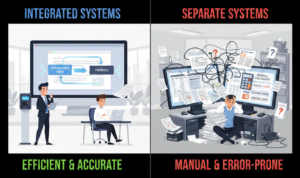
In short: Unified systems eliminate reconciliation errors.
What Is the Financial Cost of Ignoring Integration?
Direct Answer (46 words):
Ignoring system integration leads to repeated errors, compliance penalties, and wasted administrative hours. Over time, these inefficiencies cost more than implementing automated attendance and payroll software.
Payroll Risk Breakdown
Annual Payroll Risk Distribution
Manual Errors: ███████████████ 35%
Compliance Penalties: ███████████ 25%
Administrative Delays: █████████████ 30%
Employee Dissatisfaction: ██████ 10%
Glossy Insight:
More than 60% of payroll inefficiencies arise from disconnected systems.
How Does This Apply to Businesses in India?
India’s regulatory landscape includes PF, ESI, TDS, and professional tax requirements across different states.
How does this apply to businesses in India?
For Indian businesses, integrating attendance and payroll ensures statutory deductions match actual working hours. It simplifies compliance in states such as Maharashtra, Gujarat, Karnataka, and Delhi. SMEs especially benefit from reduced administrative workload and improved audit readiness.
In short: Integration aligns salary processing with Indian labor laws.
What Features Should You Look for in Attendance and Payroll Software?
When selecting attendance and payroll software, prioritize real-time attendance syncing, automated overtime calculation, compliance updates, secure cloud storage, and audit-ready reporting.
Must-Have Features
- Biometric or GPS tracking
- Leave auto-adjustment
- Real-time statutory updates
- Digital payslip generation
- Employee self-service portal
How Can SMEs Scale Efficiently with Integrated Systems?
Small and mid-sized businesses can grow faster when salary processing is automated. Integrated attendance and payroll reduces operational bottlenecks and compliance concerns.
Benefits for SMEs:
- Lower administrative cost
- Improved accuracy
- Faster processing cycles
- Better workforce transparency
FAQs
Why is attendance and payroll integration important for small businesses?
Integration ensures salary calculations are based on accurate time records. Small businesses benefit from fewer disputes, lower compliance risks, and reduced administrative workload, allowing them to focus on growth.
Can attendance and payroll systems reduce compliance penalties?
Yes. Automated integration ensures statutory deductions are calculated correctly and updated regularly, minimizing compliance violations and audit risks.
Is attendance and payroll software suitable for remote teams?
Absolutely. Cloud-based platforms allow GPS or mobile attendance tracking, ensuring accurate salary processing for distributed teams across India.
How secure are integrated payroll systems?
Most systems use encrypted infrastructure, role-based access controls, and secure backups to protect sensitive employee salary data.
How long does implementation take?
Deployment timelines vary by company size, but most cloud-based systems can be implemented within days to a few weeks.
Conclusion: Why Should You Integrate Your Systems Now?
Disconnected processes create errors, compliance exposure, and operational inefficiencies. Integrated attendance and payroll systems deliver accuracy, transparency, and scalability — especially important for Indian businesses operating under strict regulations.
In short: Accurate salaries start with accurate work data.
If your organization still manages time tracking and salary processing separately, now is the time to modernize. Invest in an integrated solution that strengthens compliance, improves employee trust, and supports long-term business growth.