What Should Employers Update in Payroll Software Under the New Tax Regime 2026?
Payroll software drives salary accuracy in modern organizations. Whenever tax regulations shift, employers must immediately adjust system configurations. Otherwise, even small calculation errors can multiply across hundreds of employees.
In 2026, the revised tax structure introduces several operational adjustments.
In short: Tax reform requires structured payroll reconfiguration — not temporary manual fixes.
The new tax regime 2026 payroll framework directly affects TDS logic, salary architecture, declaration workflows, and reporting formats.
Why Must Employers Update Payroll Software Under the New Tax Regime 2026 Payroll?
Direct Answer (55 words):
It rules introduce revised slabs, rebate adjustments, and modified deduction logic. Therefore, payroll systems must reflect these changes immediately to ensure accurate TDS calculations and statutory compliance. Otherwise, employers risk salary discrepancies and audit complications.
What Risks Arise Without Updates?
Incorrect TDS deductions
Employee dissatisfaction
Compliance penalties
Audit exposure
Year-end reconciliation challenges
Definition-style explanation:
Payroll configuration defines how tax slabs, exemptions, deductions, and reporting rules operate inside payroll software. When tax rules evolve, configuration must evolve as well.
What Core Settings Should Employers Modify in Payroll Systems?
Direct Answer (54 words):
Under the new tax regime 2026 payroll requirements, employers must actively update tax slab mapping, rebate eligibility, surcharge logic, and deduction applicability. Moreover, payroll software must apply the correct regime automatically based on employee selection.
What Should Employers Reconfigure First?
Income tax slab structure
Standard deduction calculations
Rebate and surcharge thresholds
Employee tax declaration module
Tax regime selection toggle
In short: Software settings must mirror the revised tax blueprint.
How Does the New Tax Regime 2026 Payroll Affect TDS Calculations?
Direct Answer (56 words):
The new tax regime 2026 payroll changes how payroll systems calculate taxable income and deduct TDS monthly. Consequently, employers must configure dynamic recalculation mechanisms, especially if employees switch tax regimes during the financial year.
What Must Payroll Teams Verify?
Updated slab percentages
Monthly vs annualized tax projection
Employee regime selection tracking
Mid-year recalculation logic
In short: TDS automation must become intelligent and adaptable.
How Should Salary Structures Be Adjusted Under the New Tax Regime 2026 Payroll?
Salary structures may require reclassification to align with revised tax provisions. Under the new tax regime 2026 payroll framework, employers should clearly separate taxable and non-taxable components inside payroll software.
What Structural Adjustments Are Necessary?
Reclassify outdated allowances
Remove obsolete exemptions
Tag taxable components correctly
Update salary templates
In short: Salary architecture must align with tax transparency.
What Reporting & Compliance Modules Require Updates?
Employers must update Form 16 formats, TDS return structures, and compliance exports to match the revised tax environment. Additionally, payroll systems should generate accurate quarterly statements under the new tax regime 2026 payroll.
What Reports Demand Immediate Attention?
Monthly TDS reports
Annual Form 16
Tax declaration summaries
Audit-ready exports
In short: Reporting accuracy reinforces deduction accuracy.
What Benefits Do Employers Gain by Updating New Tax Regime 2026 Payroll Settings?
Benefit Overview Table
| Update Area | Employer Benefit | Estimated Impact |
|---|---|---|
| Slab Automation | Accurate TDS | +50% precision |
| Dynamic Regime Toggle | Reduced disputes | +40% clarity |
| Automated Reports | Faster compliance | +45% efficiency |
| Structured Templates | Transparent payroll | +35% trust |
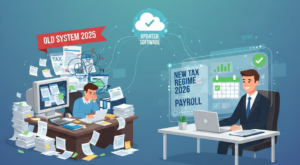
When employers update payroll systems promptly, they reduce disputes and strengthen compliance reliability. Furthermore, automation minimizes manual intervention and enhances employee confidence.
In short: Proactive updates stabilize payroll cycles.
How Does the 2026 Payroll Setup Differ From Previous Tax Configurations?
Comparison Table
| Configuration Area | Previous Setup | 2026 Setup |
|---|---|---|
| Tax Slab Mapping | Static configuration | Dynamic logic |
| Regime Selection | Limited flexibility | Employee toggle |
| Reporting Validation | Manual checks | Automated |
| Mid-Year Adjustments | Complex | System-driven |
In short: Payroll systems now emphasize automation over manual intervention.
What Is the Cost of Ignoring New Tax Regime 2026 Payroll Updates?
If employers delay system updates, payroll teams may deduct incorrect TDS or miscalculate take-home salary. As a result, organizations may face compliance penalties, reconciliation gaps, and employee disputes.
Payroll Risk Breakdown Chart
Payroll Risk Without Update
Incorrect TDS: █████████████ 30%
Salary Disputes: ███████████ 25%
Compliance Penalties: █████████ 20%
Reconciliation Errors: ████████████ 25%
In short: Ignoring updates increases long-term correction costs.
How Does This Apply to Businesses in India?
Indian employers across Mumbai, Delhi, Bengaluru, Ahmedabad, Hyderabad, and Chennai must implement updates consistently.
How does this apply to businesses in India?
Direct Answer (57 words):
For Indian businesses operating across multiple states, It demands centralized configuration management. Therefore, companies must ensure uniform system updates across branches in Maharashtra, Karnataka, Gujarat, and Delhi.
In short: Centralized tax governance prevents regional inconsistencies.
FAQs
What is the new tax regime 2026 payroll update?
It refers to mandatory configuration changes in payroll software to align with revised tax slabs, rebate logic, and TDS reporting requirements introduced in 2026.
Do employers need to modify salary structures?
Yes. Employers must adjust allowances, taxable components, and exemption tagging to match updated tax rules.
Can employees switch tax regimes mid-year?
If regulations allow, payroll software must dynamically recalculate TDS based on the updated selection.
What happens if payroll software remains outdated?
Employers may deduct incorrect TDS, which can trigger penalties, employee disputes, and reconciliation challenges.
Is payroll automation necessary in 2026?
Yes. Automation ensures accurate slab application and reduces manual miscalculations.
Conclusion: Why Should Employers Act Before Payroll Errors Escalate?
Tax reforms require more than accounting awareness; they require system readiness. Employers must configure payroll software carefully to align with regulatory updates.
The new tax regime 2026 payroll environment demands automation, recalibration, and structured compliance reporting.
In short: Smart payroll systems must evolve proactively.
Employers who act early will ensure payroll accuracy, regulatory compliance, and long-term workforce trust in 2026 and beyond.