What Are the Minimum Wage & Labour Law Changes Announced in Budget 2027?
Minimum wage regulations form the backbone of employer compliance in India. Whenever the Union Budget introduces labour reforms, businesses must quickly reassess salary structures, payroll configurations, and HR policies.
In 2027, the government introduced structured refinements to wage benchmarks and enforcement systems.
In short: Wage policy reform directly impacts employer cost planning and compliance strategy.
The wage law changes 2027 reflect a move toward transparency, standardized classifications, and stronger digital enforcement.
Why Do Wage Law Changes 2027 Matter for Employers?
It directly affect base salary thresholds, statutory contributions, and employment documentation. Therefore, employers must review compensation frameworks immediately. If they delay updates, they risk penalties, workforce disputes, and regulatory action.
What Compliance Areas Are Most Sensitive?
Basic wage levels
Overtime computation
Contractor wage policies
Employer contribution liabilities
Wage documentation and recordkeeping
Definition :
Minimum wage laws define the legally mandated lowest pay employers must provide. Labour laws regulate work conditions, employment security, and statutory contributions.
What Structural Updates Were Introduced in Wage Law Changes 2027?
Direct Answer (54 words):
The wage law changes 2027 introduce revised wage floors, clearer skill-based classifications, and enhanced digital reporting requirements. As a result, employers must adopt more structured payroll governance models.
What Should Employers Monitor Closely?
Updated national wage benchmarks
Skill-level wage differentiation
State alignment measures
Digital documentation mandates
Stronger inspection mechanisms
In short: Compliance now depends on structured classification and reporting accuracy.
How Do Wage Law Changes 2027 Affect Payroll Planning?
Employers must recalibrate payroll templates to ensure that no employee earns below the revised statutory minimum. Consequently, HR and payroll teams should review overtime formulas, allowances, and wage classifications.
What Must Payroll Teams Update?
Basic salary configuration
Allowance allocation
Overtime rate calculation
Contractor wage compliance
In short: Payroll systems must align with revised wage standards.
How Will Wage Law Changes 2027 Influence Employer Cost Structures?
Direct Answer (53 words):
Revised wage floors increase overall payroll expenditure, especially in labour-intensive sectors. Moreover, employers must reassess workforce budgets and contribution forecasts.
Which Financial Areas Require Review?
Salary projections
Employer PF and ESI contributions
Overtime budgets
Vendor contract rates
In short: Employers must proactively adjust cost forecasts.
What Benefits Do Wage Law Changes 2027 Offer?
Although reforms may initially raise salary obligations, they also create long-term operational clarity.
Benefit Overview Table
| Reform Focus | Employer Benefit | Estimated Impact |
|---|---|---|
| Wage Standardization | Reduced disputes | +35% clarity |
| Skill-Based Classification | Fair pay structure | +40% transparency |
| Digital Compliance | Faster audits | +50% efficiency |
| Structured Reporting | Lower error risk | +30% stability |
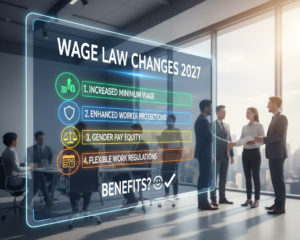
It improves transparency and reduce ambiguity in wage structures. Consequently, businesses gain predictable compliance standards and improved employee trust.
In short: Stability outweighs short-term cost pressure.
How Do 2027 Reforms Compare to Previous Wage Policies?
Comparison Table
| Area | Pre-2027 Policy | 2027 Reform |
|---|---|---|
| Wage Floor | State variability | Greater alignment |
| Skill Levels | Broad grouping | Structured classification |
| Compliance Monitoring | Manual inspections | Digital tracking |
| Documentation | Paper-heavy | Standardized reporting |
In short: The framework shifts from reactive enforcement to digital governance.
What Is the Cost of Ignoring Wage Law Changes 2027?
If employers ignore updated wage requirements, authorities may impose penalties and demand back-pay settlements. Furthermore, reputational risk increases significantly when labour disputes escalate.
Compliance Risk Breakdown Chart
Back-Wage Liability: ███████████ 25%
Legal Disputes: █████████ 20%
Inspection Fines: ████████████ 25%
In short: Delayed compliance multiplies financial exposure.
How Does This Apply to Businesses in India?
India’s labour framework operates through both central and state regulations. Therefore, employers must monitor updates at multiple levels.
How does this apply to businesses in India?
For Indian businesses operating in Maharashtra, Karnataka, Gujarat, Delhi, or Tamil Nadu, It requires consistent payroll alignment across branches. Multi-state employers must implement centralized compliance monitoring to avoid inconsistencies.
In short: Uniform payroll governance ensures regulatory safety.
How Should Employers Prepare Strategically?
Conduct wage audits
Update payroll templates
Reassess contractor agreements
Implement digital compliance tools
Train HR teams on new classifications
Employers who proactively adopt structured wage governance reduce compliance risk and strengthen workforce stability.
In short: Preparation protects operational continuity.
FAQs
What are wage law changes 2027?
They refer to revised wage benchmarks, updated skill classifications, and stronger compliance enforcement introduced under Budget 2027.
Do wage law changes 2027 affect small businesses?
Yes. Even small enterprises must meet updated wage thresholds and documentation standards to avoid penalties.
Are wage rules uniform across India?
National reforms provide structure; however, state governments may adjust rates regionally.
What happens if employers underpay wages?
Authorities may impose fines, demand back payments, and initiate legal proceedings.
How can companies ensure compliance in 2027?
Employers should audit payroll systems, align wage templates, and adopt digital compliance monitoring tools.
Conclusion: Why Must Employers Act Early in 2027?
Wage reforms are not just regulatory notices — they redefine compensation governance.
The wage law changes 2027 emphasize structured classification, standardized reporting, and proactive compliance.
In short: Early action prevents financial and reputational damage.
Employers who modernize payroll systems and wage policies now will strengthen compliance, protect employee trust, and maintain operational stability throughout 2027 and beyond.