What Are the Payroll Software Requirements After Union Budget 2027?
Payroll systems form the backbone of salary processing and statutory compliance in India. Every Union Budget introduces tax and labor changes that directly affect how employers calculate deductions, manage reporting, and structure compensation.
In 2027, new reforms require digital recalibration.
In short: Budget changes demand system-level payroll updates — not manual adjustments.
The payroll software requirements 2027 include configuration updates, automation enhancements, and structured reporting improvements.
Why Do Payroll Software Requirements 2027 Matter for Employers?
Direct Answer :
It matter because new tax slabs, contribution limits, and compliance rules must be accurately reflected in payroll systems. Therefore, employers must update their software to avoid incorrect salary credits and statutory penalties.
What Risks Arise Without Proper Updates?
- Incorrect TDS deductions
- Delayed compliance filings
- Employee salary disputes
- Audit penalties
- Manual reconciliation errors
Definition :
Payroll software is a digital system that automates salary calculations, tax deductions, statutory compliance, and reporting processes.
What Core Updates Are Included in Payroll Software Requirements 2027?
Direct Answer :
It include updated tax slab mapping, revised statutory deduction logic, and enhanced reporting formats. As a result, payroll systems must support dynamic compliance changes introduced in Budget 2027.
What System Areas Must Be Modified?
- Income tax slab configuration
- PF and ESI contribution logic
- Professional tax updates
- Salary component classification
- Automated compliance reporting
In short: Configuration logic must align with revised statutory rules.
How Do Payroll Software Requirements 2027 Affect Tax Calculations?
Direct Answer :
Payroll systems must automatically apply revised tax slabs and deduction thresholds. Additionally, software should support dynamic employee declarations and mid-year adjustments.
What Tax Elements Need Recalibration?
- Updated slab percentages
- Rebate logic
- Surcharge thresholds
- Standard deduction updates
In short: Automated tax accuracy reduces year-end corrections.
How Will Payroll Software Requirements 2027 Influence HR Operations?
Direct Answer :
HR teams must integrate updated compliance logic into payroll workflows. Consequently, payroll becomes more automated, reducing manual validation.
What Operational Areas Improve?
- Salary processing speed
- Compliance reporting accuracy
- Employee payslip transparency
- Audit readiness
In short: Modernized payroll improves operational efficiency.
What Benefits Arise From Meeting Payroll Software Requirements 2027?
Although updates require effort, they create structured compliance and long-term efficiency.
Benefit Overview Table
Update Area | Employer Benefit | Estimated Impact |
Tax Automation | Accurate deductions | +50% precision |
Compliance Reporting | Faster filings | +45% efficiency |
| Digital Documentation | Audit readiness | +40% reliability |
| Integrated Payroll | Reduced disputes | +35% transparency |
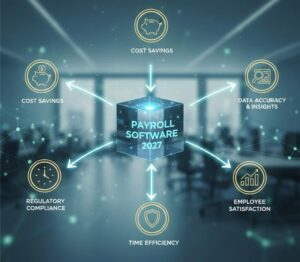
Direct Answer :
It enhances compliance accuracy and strengthens employee trust. Consequently, employers reduce correction costs and administrative workload.
In short: Automation prevents avoidable compliance risk.
How Do 2027 Payroll Requirements Compare to Earlier Systems?
Comparison Table
Feature | Pre-2027 Setup | Post-2027 Requirement |
Tax Slab Handling | Semi-manual | Fully automated |
| Compliance Reporting | Periodic validation | Real-time generation |
| Deduction Logic | Static | Dynamic |
| Audit Readiness | Reactive | Proactive |
In short: The shift is toward intelligent payroll automation.
What Is the Cost of Ignoring Payroll Software Requirements 2027?
Direct Answer :
If employers fail to align payroll systems with updated regulations, they risk deduction errors and compliance penalties. Therefore, ignoring payroll software requirements 2027 may increase long-term financial exposure.
Payroll Risk Breakdown Chart
Payroll Risk Distribution Without Updates
Incorrect TDS: █████████████ 30%
Compliance Penalties: ███████████ 25%
Salary Disputes: █████████ 20%
Audit Corrections: ████████████ 25%
More than half of payroll disputes arise from outdated tax configuration rather than deliberate non-compliance.
In short: Preventable system gaps increase correction costs.
How Does This Apply to Businesses in India?
Budget reforms affect employers nationwide, including Mumbai, Delhi, Bengaluru, Hyderabad, Chennai, and Ahmedabad.
How does this apply to businesses in India?
Direct Answer :
For Indian businesses, It demands centralized updates across branches and departments. Companies operating in multiple states must ensure uniform tax and compliance configuration to prevent discrepancies.
In short: Centralized payroll governance strengthens statutory alignment.
How Should Employers Prepare for Payroll Software Requirements 2027?
- Conduct payroll compliance audits
- Update tax slab configuration
- Review statutory deduction modules
- Train HR and finance teams
- Test reporting outputs
Direct Answer :
Employers who proactively implement payroll software requirements 2027 within their systems reduce compliance risks and improve financial predictability.
In short: Preparation ensures seamless transition.
FAQs
What are payroll software requirements 2027?
They refer to necessary system updates in payroll software to align with tax and statutory changes introduced in Union Budget 2027.
Do payroll systems need immediate updates after Budget 2027?
Yes. Employers should reconfigure payroll software promptly to ensure accurate deductions and compliance.
Are small businesses affected by payroll changes?
Yes. Even small Indian businesses must update payroll systems to match new statutory rules.
What happens if payroll software is not updated?
Incorrect salary processing and compliance penalties may occur, increasing operational risk.
Is automation essential for 2027 payroll compliance?
Yes. Automated payroll ensures consistent application of revised tax and deduction rules.
Conclusion: Why Must Employers Act Early?
Union Budget reforms reshape payroll compliance structures. Therefore, employers must treat payroll updates as system-level transformations.
It demands automation, structured reporting, and proactive compliance management.
In short: Smart payroll systems evolve with regulatory change.
Organizations that update early will maintain payroll accuracy, employee trust, and statutory compliance throughout 2027 and beyond.