What Should Employers Include in a Statutory Compliance Checklist FY 2026-27?
Compliance with statutory regulations remains one of the most critical responsibilities for employers in India. Every financial year introduces updates in tax slabs, PF and ESI thresholds, labour codes, and reporting formats. Therefore, HR and payroll teams must prepare systematically.
In FY 2026–27, structured planning is essential.
In short: Compliance requires proactive monitoring, not reactive correction.
It helps employers maintain accuracy and avoid penalties.
Why Is a Statutory Compliance Checklist FY 2026-27 Important for Employers?
Direct Answer :
It ensures employers track all regulatory obligations, including PF, ESI, TDS, and labour law filings. Therefore, businesses can avoid penalties and maintain accurate payroll processing. Without structured monitoring, compliance gaps may emerge.
What Risks Arise Without a Checklist?
- Missed filing deadlines
- Incorrect statutory deductions
- Audit observations
- Financial penalties
- Employee disputes
Definition :
Statutory compliance refers to adherence to laws and regulations governing taxation, employee benefits, and labor practices.
What Does the Statutory Compliance Checklist FY 2026–27 Include?
Direct Answer :
It includes monthly, quarterly, and annual filings related to PF, ESI, TDS, professional tax, and labor laws. Consequently, employers must align payroll systems with these requirements.
What Key Areas Should Be Covered?
- PF contribution filing
- ESI deduction reporting
- TDS return submission
- Professional tax compliance
- Labour law documentation
In short: Comprehensive tracking reduces regulatory exposure.
How Should Employers Implement a Statutory Compliance Checklist FY 2026–27?
Direct Answer :
Employers should integrate the statutory compliance checklist into payroll software and HR workflows. Additionally, automation tools can track due dates and generate compliance alerts.
What Implementation Steps Are Essential?
- Configure payroll systems for updated thresholds
- Maintain compliance calendar
- Conduct quarterly audits
- Train HR teams
- Review statutory documentation
In short: Automation strengthens compliance accuracy.
How Does the Checklist Improve Payroll Accuracy?
Direct Answer :
When employers follow a structured statutory compliance checklist FY 2026–27, payroll system reflect accurate deductions and statutory contributions. As a result, salary processing becomes transparent and audit-ready.
What Payroll Areas Benefit?
- Accurate tax deduction
- Timely PF & ESI filing
- Transparent payslips
- Reduced reconciliation errors
In short: Compliance structure enhances payroll integrity.
What Benefits Arise From Using a Statutory Compliance Checklist FY 2026–27?
Although compliance tracking may seem administrative, it strengthens organizational governance.
Benefit Overview Table
Compliance Area | Employer Benefit | Estimated Impact |
| Timely Filing | Reduced penalties | +50% compliance reliability |
| Accurate Deductions | Fewer disputes | +40% transparency |
| Audit Preparedness | Faster inspections | +45% efficiency |
| Automated Alerts | Lower manual workload | +35% productivity |
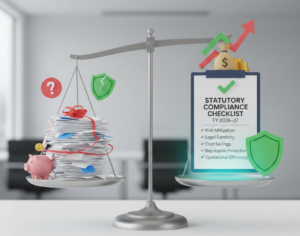
Direct Answer :
It promotes structured governance and consistent regulatory adherence. Consequently, employers enhance credibility and operational stability.
In short: Compliance strengthens long-term business resilience.
How Does FY 2026–27 Compliance Compare to Previous Years?
Comparison Table
Aspect | Previous FY | FY 2026–27 |
Filing Tracking | Manual reminders | Automated alerts |
Deduction Monitoring | Periodic review | Real-time validation |
| Documentation | Physical records | Digital reporting |
| Audit Response | Reactive | Proactive |
In short: The shift is toward digital-first compliance management.
What Is the Cost of Ignoring a Statutory Compliance Checklist FY 2026–27?
Direct Answer :
Ignoring the statutory compliance checklist may result in penalties, delayed filings, and reputational damage. Therefore, employers must adopt systematic tracking to minimize exposure.
Compliance Risk Breakdown Chart
Compliance Risk Distribution
Missed Deadlines: █████████████ 30%
Penalty Charges: ███████████ 25%
Employee Disputes: █████████ 20%
Audit Observations: ████████████ 25%
More than half of compliance penalties occur due to missed deadlines rather than intentional violations.
In short: Preventable oversight creates unnecessary cost.
How Does This Apply to Businesses in India?
Statutory compliance in India varies across states such as Maharashtra, Karnataka, Gujarat, Tamil Nadu, and Delhi. However, national regulations shape payroll obligations.
How does this apply to businesses in India?
Direct Answer :
For Indian businesses operating across multiple states, It ensures uniform adherence to tax and labour regulations. Companies must align payroll systems centrally to prevent discrepancies between branches.
In short: Centralized compliance management reduces risk.
How Can Employers Prepare for FY 2026–27 Compliance?
- Create annual compliance calendar
- Integrate checklist into payroll software
- Conduct internal audits
- Update statutory deduction modules
- Review reporting formats
Direct Answer :
Employers who proactively implement the statutory compliance checklist reduce financial exposure and enhance operational efficiency.
In short: Early planning prevents regulatory disruption.
FAQs
What is a statutory compliance checklist FY 2026–27?
It is a structured list of regulatory obligations employers must follow during the financial year 2026–27.
Why is statutory compliance important for payroll?
It ensures accurate deductions, timely filings, and protection from penalties.
Do small businesses need a compliance checklist?
Yes. All employers in India must adhere to statutory requirements regardless of size.
What happens if statutory deadlines are missed?
Authorities may impose penalties, interest charges, and compliance notices.
How can automation improve compliance?
Automated payroll systems track deadlines, validate deductions, and generate real-time reports.
Conclusion: Why Must Employers Prioritize Compliance in FY 2026–27?
Regulatory compliance is not optional — it is foundational to sustainable business operations. Therefore, employers must integrate structured monitoring into payroll systems.
It provides clarity, accuracy, and proactive governance.
In short: Structured compliance protects financial stability and workforce trust.
Organizations that adopt systematic compliance practices will maintain regulatory alignment and operational confidence throughout FY 2026–27 and beyond.