Is an Automated Payroll System the Smartest Way to Eliminate Payroll Errors and Compliance Risks?
Payroll mistakes, delayed salaries, tax miscalculations, and compliance penalties are common problems for growing companies. Many businesses still depend on spreadsheets or disconnected HR tools. As workforce size increases, so do payroll complexities—multiple salary structures, PF, ESI, TDS, bonuses, and overtime calculations. An Automated Payroll System helps businesses eliminate these risks by replacing manual calculations with structured, rule-based processing.
In short: Manual payroll processes increase financial risk, reduce employee trust, and consume HR time.
An Automated Payroll System addresses these issues through rule-based automation, real-time compliance updates, and seamless integration with attendance and leave data.
Why Do Manual Payroll Systems Create Serious Business Risks?
Manual payroll systems rely heavily on spreadsheets, human data entry, and outdated formulas. This increases the likelihood of tax errors, incorrect deductions, and delayed salary processing. As workforce size grows, manual errors multiply, leading to compliance penalties, employee dissatisfaction, and reputational damage.
What Common Payroll Errors Happen Without Automation?
- Incorrect tax slab calculation
- Missed PF/ESI deductions
- Attendance mismatches
- Overtime miscalculations
- Duplicate or delayed payments
Definition-style explanation:
Payroll risk refers to financial, legal, and operational consequences arising from incorrect salary processing or statutory non-compliance.
What Is an Automated Payroll System and How Does It Work?
An Automated Payroll System is software that calculates employee salaries, deductions, taxes, bonuses, and statutory contributions automatically using predefined rules. It integrates attendance, leave, and compliance data to generate accurate payslips while ensuring adherence to labor laws and tax regulations.
How Does Payroll Automation Actually Function?
- Attendance data syncs automatically
- Salary structures are predefined
- Statutory rules are applied in real time
- Net salary is calculated instantly
- Digital payslips are generated
In short: It replaces repetitive manual calculations with rule-based processing.
Why Does Payroll Accuracy Matter More Than Ever in 2026?
Payroll accuracy directly impacts employee trust, financial stability, and regulatory compliance. Even small miscalculations can result in legal penalties and workforce dissatisfaction. In 2026, stricter compliance rules and digital audits make automation not just helpful—but essential.
What Happens When Payroll Goes Wrong?
- Loss of employee confidence
- Government penalties
- Increased HR workload
- Audit risks
A modern Automated Payroll System minimizes these exposures significantly.
What Are the Key Benefits of an Automated Payroll System?
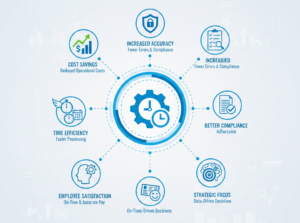
An Automated Payroll System improves efficiency, ensures compliance, reduces payroll errors, enhances transparency, and saves administrative time. It enables HR teams to focus on strategic growth instead of repetitive calculations, while employees receive accurate and timely salaries.
Benefit Breakdown Table
|
Benefit |
Business Impact | Efficiency Gain |
|
Error Reduction |
Fewer salary disputes | +70% accuracy |
|
Compliance Automation |
Reduced penalties |
+60% compliance control |
| Time Saving | Faster processing |
+50% HR productivity |
| Digital Payslips | Increased transparency |
+40% employee trust |
How Does an Automated Payroll System Compare to Manual Payroll?
Comparison Table
|
Feature |
Manual Payroll | Automated Payroll System |
|
Error Rate |
High | Very Low |
|
Compliance Updates |
Manual tracking | Automatic |
| Processing Time | 2–5 days |
Few hours |
| Scalability | Limited |
High |
| Audit Readiness | Weak |
Strong |

In short: Automation delivers speed, accuracy, and compliance scalability.
What Is the Cost of Ignoring Payroll Automation?
Ignoring payroll automation increases operational costs through penalties, rework, disputes, and compliance risks. Over time, these hidden expenses exceed the investment required for an Automated Payroll System, making manual processing more expensive in the long run.
Financial Risk Snapshot (Percentage Chart)
Payroll Error Impact Analysis (Annual)
Human Errors: ███████████████ 35%
Compliance Penalties: ██████████ 25%
Time Wastage: █████████████ 30%
Employee Dissatisfaction: ██████ 10%
In short :
Over 60% of payroll-related losses stem from manual inefficiencies and compliance gaps.
How Does This Apply to Businesses in India?
India has complex statutory requirements including PF, ESI, TDS, Professional Tax, and state-specific labor regulations. For Indian businesses, compliance accuracy is critical.
How does this apply to businesses in India?
For Indian businesses, an Automated Payroll System ensures accurate PF, ESI, and TDS calculations while adapting to frequent regulatory updates. It simplifies multi-state compliance requirements and supports audit readiness. This is especially valuable for SMEs and startups navigating India’s evolving tax framework.
In short: Automation strengthens payroll compliance management across Indian states.
How Can Growing SMEs Benefit from Payroll Automation?
- Reduce HR administrative burden
- Improve salary accuracy
- Scale without adding payroll staff
- Ensure compliance with Indian labor laws
A cloud-based Automated Payroll System allows SMEs to manage expansion without increasing risk.
What Features Should You Look for in Payroll Automation Software?
When selecting an Automated Payroll System, prioritize compliance updates, attendance integration, digital payslip generation, data security, scalability, and audit-ready reporting. These features ensure long-term reliability and regulatory safety.
Must-Have Features
- Real-time statutory updates
- Attendance integration
- Overtime automation
- Secure employee self-service portal
- Detailed reporting dashboard
FAQs
Is an Automated Payroll System suitable for small businesses?
Yes. Small businesses benefit greatly from automation because it reduces manual errors, saves time, and ensures statutory compliance without hiring additional payroll staff. It supports growth while maintaining financial accuracy and employee satisfaction.
Can payroll automation reduce compliance penalties?
Absolutely. Automation applies updated tax and labor regulations automatically, minimizing calculation errors and missed contributions. This significantly reduces the risk of penalties and audit failures.
How secure is payroll automation software?
Most modern solutions use encrypted cloud infrastructure, role-based access control, and secure backups. This ensures employee salary data remains confidential and protected from unauthorized access.
Does payroll automation integrate with attendance systems?
Yes. A well-designed Automated Payroll System syncs attendance, leave records, and overtime data automatically, eliminating discrepancies between work hours and salary calculations.
How long does it take to implement payroll automation?
Implementation timelines vary, but most cloud-based systems can be configured within a few days to a few weeks depending on workforce size and customization needs.
Conclusion: Is It Time to Upgrade Your Payroll Process?
Payroll is not just about paying salaries—it is about compliance, trust, and operational efficiency. Manual systems expose businesses to errors, penalties, and wasted resources.
An Automated Payroll System offers structured, accurate, and scalable payroll management. It reduces errors, strengthens compliance, and improves transparency—especially for Indian businesses operating under complex tax regulations.
In short: Automation is no longer optional; it is a strategic necessity.
If your organization is still relying on spreadsheets, now is the time to transition toward a smarter payroll framework. Evaluate your current payroll risks and consider adopting a modern automation solution that supports growth, compliance, and long-term efficiency.