How Can Businesses Avoid Payroll Penalties After Budget 2026?
Budget reforms often reshape payroll compliance obligations. After Budget 2026, businesses must review tax slabs, contribution thresholds, and statutory reporting rules. Even minor miscalculations can trigger financial penalties and employee dissatisfaction.
Therefore, proactive preparation is essential.
In short: Preventing penalties requires system-level payroll alignment.
The risk of payroll penalties Budget 2026 increases when employers delay compliance updates.
Why Do Payroll Penalties Budget 2026 Pose a Serious Risk?
Direct Answer :
The payroll penalties Budget 2026 risk arises from outdated tax configurations, incorrect statutory deductions, and delayed filings. Therefore, businesses must update payroll software promptly to remain compliant. If they fail to act, authorities may impose financial penalties and interest charges.
What Common Errors Lead to Payroll Penalties?
- Incorrect TDS deductions
- Missed PF or ESI filings
- Wrong salary classification
- Delayed compliance reporting
- Manual payroll errors
Definition :
Payroll penalties are fines or interest charges imposed when employers fail to comply with statutory tax and labor regulations.
What Changes After Budget 2026 Increase Payroll Compliance Risk?
Direct Answer :
Budget 2026 may revise tax slabs, PF ceilings, or reporting standards. Consequently, businesses must realign payroll logic to prevent calculation errors.
Which Compliance Areas Are Most Sensitive?
- Income tax deduction logic
- PF contribution thresholds
- ESI eligibility mapping
- Professional tax updates
- Digital reporting formats
In short: Updated rules require payroll recalibration.
How Can Businesses Prevent Payroll Penalties Budget 2026 Through Automation?
Direct Answer :
Companies can reduce payroll penalties Budget 2026 by automating tax calculations and compliance reminders. Additionally, payroll system should validate employee data in real time.
What Automation Features Matter Most?
- Automated tax slab mapping
- Compliance due-date alerts
- Digital audit trails
- Real-time deduction validation
- Integrated statutory reporting
In short: Automation minimizes manual errors.
How Should Employers Conduct a Payroll Compliance Audit After Budget 2026?
Direct Answer :
A payroll audit identifies mismatches between updated statutory rules and payroll configurations. Therefore, employers should conduct quarterly reviews to prevent payroll penalties Budget 2026.
What Audit Steps Are Recommended?
- Review updated tax slabs
- Verify PF and ESI calculations
- Cross-check TDS filings
- Validate employee declarations
In short: Regular audits detect errors early.
What Are the Benefits of Avoiding Payroll Penalties Budget 2026?
Although compliance requires effort, it strengthens operational stability.
Benefit Overview Table
|
Compliance Focus |
Employer Benefit | Estimated Impact |
|
Accurate Deductions |
Reduced disputes | +40% clarity |
| Timely Filing | Lower penalties |
+50% cost savings |
| Digital Reporting | Faster audits |
+45% efficiency |
| Automated Alerts | Reduced workload |
+35% productivity |
Direct Answer :
Avoiding payroll penalties Budget enhances financial predictability and strengthens employer credibility. Consequently, businesses build trust with employees and regulators.
In short: Compliance protects both reputation and profitability.
How Do Post-2026 Payroll Systems Compare to Earlier Structures?
Comparison Table
|
Feature |
Before Budget 2026 | After Budget 2026 |
|
Tax Slab Handling |
Semi-manual | Automated |
|
Deduction Monitoring |
Periodic review |
Real-time validation |
| Reporting | Manual submission |
Digital filing |
| Compliance Risk | Moderate |
Lower (with updates) |
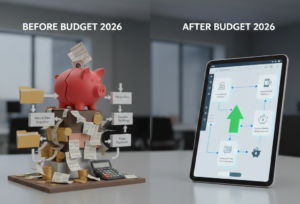
In short: The shift favors structured automation.
What Is the Cost of Ignoring Payroll Penalties Budget 2026?
Direct Answer :
Ignoring compliance updates may result in penalties, interest charges, and reputational harm. Therefore, businesses must prioritize system alignment.
Payroll Risk Breakdown Chart
Payroll Risk Distribution
Incorrect TDS: █████████████ 30%
Late Filings: ███████████ 25%
PF/ESI Errors: █████████ 20%
Audit Corrections: ████████████ 25%
Over 50% of payroll disputes arise from outdated tax configuration rather than intentional violations.
In short: Preventable oversight increases financial exposure.
How Does This Apply to Businesses in India?
Indian businesses across Mumbai, Delhi, Bengaluru, Hyderabad, Chennai, and Ahmedabad must adapt uniformly to post-budget changes.
How does this apply to businesses in India?
Direct Answer :
For Indian employers, avoiding payroll penalties Budget requires centralized payroll updates and structured compliance tracking. Multi-location organizations must ensure uniform tax configuration across branches.
In short: Centralized payroll governance reduces compliance gaps.
How Can Employers Build a Strong Post-Budget Compliance Strategy?
- Update payroll software immediately
- Train HR and finance teams
- Schedule quarterly compliance reviews
- Maintain digital documentation
- Implement automated reporting tools
Direct Answer :
Employers who proactively implement structured compliance strategies reduce payroll penalties Budget 2026 risk and enhance operational efficiency.
In short: Prevention is always more cost-effective than correction.
FAQs
What causes payroll penalties after Budget 2026?
Payroll penalties often result from outdated tax configurations, missed statutory filings, and incorrect deductions.
How can automation reduce payroll penalties?
Automation ensures real-time validation of deductions and tracks statutory deadlines.
Are small businesses at risk of payroll penalties?
Yes. All employers in India must comply with updated statutory regulations.
How often should payroll audits be conducted?
Quarterly audits help detect discrepancies before penalties occur.
What happens if payroll compliance deadlines are missed?
Authorities may impose financial penalties, interest charges, and audit notices.
Conclusion: Why Must Businesses Act Immediately After Budget 2026?
Budget updates reshape payroll compliance structures. Therefore, employers must align systems promptly to avoid financial and operational disruption.
The risk of payroll penalties Budget 2026 increases when businesses delay updates or rely on manual processes.
In short: Structured automation prevents avoidable penalties.
Organizations that act early will maintain payroll accuracy, regulatory alignment, and long-term financial stability in 2026 and beyond.