What Is the Best HR & Payroll Software for Multi-Branch Companies in 2026?
Managing HR and payroll across multiple branches has become increasingly complex in 2026. With changing tax regulations, varying state compliance rules, and expanding workforces, companies must ensure consistent payroll governance across all locations.
Manual systems no longer suffice.
In short: Multi-branch operations demand centralized automation.
Therefore, choosing the best HR payroll software 2026 becomes essential for scalability and compliance.
Why Do Multi-Branch Companies Need the Best HR Payroll Software 2026?
Direct Answer :
Multi-branch companies need the best HR payroll software 2026 to centralize salary processing, automate compliance updates, and manage statutory obligations across locations. Therefore, a unified system prevents inconsistencies and reduces administrative workload.
What Challenges Do Multi-Location Businesses Face?
- Different state tax regulations
- PF and ESI threshold variations
- Salary discrepancies between branches
- Delayed compliance filings
- Manual reconciliation errors
Definition :
HR and payroll software integrates employee data, attendance, salary calculation, and statutory compliance into one centralized system.
What Features Should the Best HR Payroll Software 2026 Include?
Direct Answer :
The best HR payroll software 2026 should offer centralized dashboard control, automated statutory updates, and branch-wise reporting. Additionally, it must support real-time payroll synchronization across locations.
What Core Capabilities Matter?
- Centralized compliance monitoring
- Automated PF, ESI, and TDS calculations
- Multi-branch reporting
- Secure cloud access
- Employee self-service portals
In short: Scalability and automation are critical.
How Does Multi-Branch Payroll Software Work in 2026?
Direct Answer :
Modern systems collect employee data from all branches and apply uniform payroll rules centrally. Consequently, companies maintain consistent tax and contribution calculations across regions.
How Does the Process Operate?
- Consolidate branch employee data
- Apply centralized payroll logic
- Calculate statutory deductions
- Generate unified compliance reports
- Enable branch-level transparency
In short: Centralization eliminates inconsistency.
How Does the Best HR Payroll Software 2026 Improve Compliance?
Direct Answer :
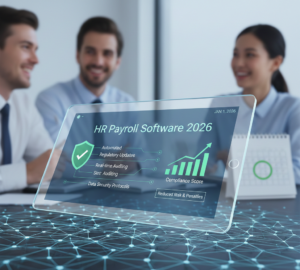
By automating statutory updates and tracking regulatory changes, the best HR payroll software 2026 ensures compliance accuracy across branches. Therefore, organizations reduce audit risks and financial penalties.
What Compliance Advantages Are Gained?
- Real-time regulatory updates
- Digital filing integration
- Automated alerts
- Central audit trail
In short: Compliance automation minimizes risk.
What Are the Benefits of Using the Best HR Payroll Software 2026?
While implementation requires planning, automation delivers measurable improvements.
Benefit Overview Table
| Feature | Employer Benefit |
Estimated Impact |
|
Centralized Dashboard |
Unified branch control | +45% visibility |
| Automated Deductions | Accurate payroll |
+50% precision |
| Compliance Alerts | Reduced penalties |
+40% risk reduction |
| Cloud Integration | Remote access |
+35% flexibility |
Direct Answer :
Choosing the best HR payroll software 2026 enhances operational efficiency and strengthens compliance reliability. Consequently, businesses achieve sustainable growth across branches.
In short: Unified payroll drives strategic expansion.
How Does Modern Multi-Branch Software Compare to Traditional Systems?
Comparison Table
| Feature | Traditional Payroll |
Modern HR & Payroll Software |
| Branch Coordination | Manual consolidation |
Centralized system |
| Compliance Monitoring | Reactive |
Proactive |
| Reporting | Fragmented |
Unified dashboard |
| Audit Readiness | Limited |
Structured |
In short: Automation transforms multi-branch payroll governance.
What Is the Cost of Ignoring Centralized Payroll Automation?
Direct Answer :
Without centralized payroll systems, businesses face increased compliance risk and operational inefficiency. Therefore, manual branch-wise management may lead to inconsistent deductions and audit exposure.
Payroll Risk Breakdown Chart
Multi-Branch Payroll Risk
Inconsistent Deductions: █████████████ 30%
Late Filings: ███████████ 25%
Salary Disputes: █████████ 20%
Audit Observations: ████████████ 25%
More than half of payroll disputes in multi-branch organizations arise from inconsistent data synchronization.
In short: Fragmentation increases compliance risk.
How Does This Apply to Businesses in India?
Indian companies operating in Mumbai, Delhi, Bengaluru, Hyderabad, Chennai, and Ahmedabad often manage diverse compliance requirements.
How does this apply to businesses in India?
Direct Answer :
For Indian businesses with branches across multiple states, the best HR payroll software ensures centralized compliance management. Consequently, companies maintain consistent statutory adherence regardless of location.
In short: Central governance strengthens national compliance alignment.
How Should Employers Select HR & Payroll Software in 2026?
- Verify multi-branch synchronization
- Ensure automatic statutory updates
- Confirm data security standards
- Evaluate compliance reporting tools
- Check scalability for expansion
Direct Answer :
Employers evaluating the best HR payroll software should prioritize automation, centralized reporting, and scalability. Therefore, they protect operations against compliance disruptions.
In short: Strategic selection supports long-term growth.
FAQs
What is the best HR payroll software 2026 for multi-branch companies?
It refers to centralized cloud-based systems that automate statutory compliance and unify payroll operations across branches.
Can payroll software handle multi-state compliance in India?
Yes. Advanced systems support state-specific tax rules and centralized management.
Does automation reduce payroll errors?
Yes. Real-time validation minimizes manual calculation mistakes.
Is centralized payroll necessary for growing companies?
Yes. Multi-branch businesses require unified systems to maintain compliance consistency.
How often should payroll software be reviewed?
Employers should review systems after major regulatory updates or quarterly.
Conclusion: Why Should Multi-Branch Companies Invest in the Best HR Payroll Software 2026?
Managing payroll across multiple branches demands centralized control and automation. Therefore, businesses must adopt systems that unify compliance management and ensure statutory accuracy.
The best HR payroll software 2026 provides scalability, precision, and regulatory confidence.
In short: Centralized automation drives compliance stability and sustainable expansion.
Companies that invest early will maintain operational efficiency and regulatory alignment throughout 2026 and beyond.