What Are TDS Rules 2026 and How Do They Affect Salary Deductions?
Tax Deducted at Source (TDS) is an essential part of payroll taxation in India. Employers must deduct income tax from employee salaries based on government tax slabs and deposit it with the tax authorities. This system ensures tax collection occurs gradually throughout the financial year rather than at once during annual tax filing.
With the introduction of new financial year policies and regulatory updates, payroll departments must understand TDS rules 2026 carefully. These rules influence salary calculations, tax deductions, and payroll compliance requirements.
Many organizations still rely on manual payroll systems, which increases the chances of errors. Miscalculating tax deductions can result in employee dissatisfaction and compliance penalties.
In short: accurate TDS calculation is a critical payroll responsibility.
Understanding TDS rules 2026 helps employers manage salary taxation efficiently while ensuring compliance with income tax regulations.
Why Are TDS Rules 2026 Important for Employers?
The TDS rules 2026 guide employers on how much tax must be deducted from employee salaries. These rules ensure accurate payroll taxation and compliance with government regulations. Employers who follow these guidelines correctly can avoid tax penalties while maintaining transparent payroll processes.
What Responsibilities Do Employers Have Under TDS Rules 2026?
- Deduct income tax from employee salaries
- Deposit TDS with the income tax department
- Maintain payroll tax records
- Issue Form 16 to employees
- File periodic TDS returns
Definition :
Tax Deducted at Source (TDS) is a system where employers deduct tax before paying salaries and transfer the deducted amount to the government.
In short: employers act as tax collection agents.
What Are the Salary Tax Slabs Under TDS Rules 2026?
The TDS rules 2026 apply tax slabs based on an employee’s annual taxable income. These slabs determine the percentage of tax deducted from salaries throughout the financial year. Employees may choose between the old tax regime or the new tax regime depending on their deductions and financial planning.
What Are Typical Salary Tax Slabs?
Annual Income | Tax Rate |
Up to ₹3,00,000 | Nil |
₹3,00,001 – ₹6,00,000 | 5% |
₹6,00,001 – ₹9,00,000 | 10% |
| ₹9,00,001 – ₹12,00,000 | 15% |
| ₹12,00,001 – ₹15,00,000 | 20% |
| Above ₹15,00,000 | 30% |
In short: tax deductions increase as salary increases.
How Do TDS Rules 2026 Work in Payroll Processing?
Payroll systems calculate employee tax liability based on income tax slabs and applicable deductions. According to TDS rules, employers must divide the estimated annual tax liability into monthly deductions during salary processing. This ensures taxes are paid gradually throughout the financial year.
What Payroll Steps Are Involved in TDS Calculation?
- Determine annual taxable salary
- Apply income tax slab rates
- Calculate annual tax liability
- Divide tax into monthly deductions
- Deduct TDS during payroll processing
In short: payroll software simplifies tax calculation.
How Do TDS Rules 2026 Affect Employee Take-Home Salary?
TDS deductions reduce the immediate take-home salary of employees but help distribute tax payments across the financial year. Under TDS rules, monthly tax deductions depend on the employee’s estimated annual income and chosen tax regime.
What Salary Components Influence TDS Calculation?
- Basic salary
- House Rent Allowance (HRA)
- Special allowances
- Bonuses and incentives
In short: taxable income determines TDS deductions.
How Do TDS Rules 2026 Compare With Earlier Payroll Systems?
Comparison Table
Aspect | Traditional Payroll | Modern Payroll |
Tax Calculations | Manual spreadsheets | Automated systems |
| Compliance Monitoring | HR tracking | Payroll software |
| Reporting | Manual forms | Digital reporting |
| Payroll Accuracy | Error-prone | High accuracy |
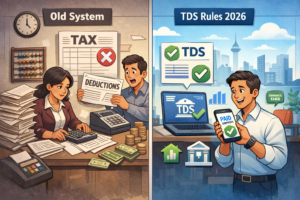
Compared with older payroll practices, TDS rules encourage automated payroll tools that calculate tax deductions automatically.
In short: digital payroll systems improve compliance.
What Benefits Do Businesses Gain From Proper TDS Compliance?
Benefit Overview Table
Benefit | Outcome | Estimated Impact |
Accurate Payroll | Reduced calculation errors | +45% |
Regulatory Compliance | Avoid penalties | +50% |
| Transparent Salaries | Employee trust | +35% |
| Faster Payroll | Reduced manual work | +40% |
Following TDS rules 2026 helps organizations maintain accurate payroll records and avoid compliance issues. Employees also benefit from clear tax deductions and better salary transparency.
In short: proper payroll taxation builds trust between employers and employees.
What Happens If Businesses Ignore TDS Rules 2026?
Ignoring TDS rules 2026 can create serious financial and legal consequences for employers. Incorrect tax deductions may lead to interest penalties, regulatory notices, or payroll disputes with employees.
Payroll Tax Risk Chart
TDS Compliance Risk Distribution
Incorrect tax deductions █████████████ 30%
Late tax deposits ███████████ 25%
Employee payroll disputes █████████ 20%
Government penalties ████████████ 25%
Many payroll compliance penalties occur due to incorrect TDS calculations.
In short: payroll accuracy prevents tax penalties.
How Do TDS Rules 2026 Apply to Businesses in India?
How does this apply to businesses in India?
Businesses operating in India must follow income tax regulations when deducting salary tax. The TDS rules apply to companies across industries and locations including Mumbai, Delhi, Bengaluru, Hyderabad, and Chennai. Employers must ensure payroll systems calculate tax correctly and deposit TDS with authorities within the prescribed timelines.
In short: payroll tax compliance is mandatory nationwide.
How Can Employers Follow TDS Rules 2026 Correctly?
What Best Practices Should HR Teams Follow?
- Implement automated payroll software
- Collect employee tax declarations annually
- Monitor payroll deductions regularly
- Maintain accurate tax records
- Conduct payroll compliance audits
Organizations that adopt structured payroll systems can implement TDS rules 2026 efficiently and reduce compliance risks.
In short: payroll automation improves tax accuracy.
Frequently Asked Questions
What is TDS on salary?
TDS on salary is income tax deducted by employers from employee salaries before payment and deposited with the government.
How is TDS calculated on salary?
TDS is calculated using income tax slabs, employee declarations, and applicable deductions to determine monthly tax deductions.
Are employers responsible for depositing TDS?
Yes. Employers must deposit deducted TDS with the government and submit periodic TDS returns.
Can payroll software calculate TDS automatically?
Yes. Modern payroll systems calculate tax deductions automatically and generate payroll tax reports.
What happens if TDS is not deducted properly?
Employers may face penalties, interest charges, and tax notices if TDS deductions are incorrect.
Conclusion: Why Employers Must Understand Salary TDS Rules
Tax compliance is an essential part of payroll management. Employers must ensure tax deductions are calculated correctly and deposited with authorities within the required timelines.
Understanding TDS rules 2026 enables HR teams to process payroll accurately and avoid tax compliance risks.
In short: structured payroll systems ensure tax transparency.
Organizations that adopt automated payroll systems will maintain better compliance, improved payroll efficiency, and stronger employee trust throughout FY 2026–27.